















Category: Uncategorized

5 minutes read
Building Key Account Management (KAM) Strategies with Environmental, Social and Governance (ESG)
The European medical technology (MedTech) landscape
The European medical technology (MedTech) landscape is undergoing a significant shift. ESG factors are no longer just buzzwords; they’re rapidly becoming essential considerations for key account management (KAM) strategies. Hospitals, healthcare providers, and other key accounts are increasingly prioritising partnerships with MedTech companies that demonstrate strong ESG performance.
A growing number of European healthcare institutions are embedding ESG criteria into their procurement decisions. A Bain & Company survey reveals that 82% of German healthcare procurement decision-makers expect ESG to become even more important in the next five years.
Vamstar’s recent study on the usage of ESG criteria in MedTech tenders across Europe highlighted the increase in usage of mandatory and value-adding criteria across Europe. One of the observations was inherent inconsistencies in objectives, criteria, and language.
The swift integration and diversification of ESG clauses by buyers present a formidable challenge in assessing associated risks. The lack of uniformity in criteria and language employed by various buyers, even within a single province, poses a significant hurdle for suppliers. Buyers exhibit diverse focal points concerning E, S and G aspects, as well as product domains dictated by their consumption patterns and local regulatory frameworks. This divergence results in a lack of standardisation in criteria among buyers, thereby complicating the evaluation process.
Organisations exhibit substantial diversity in their objectives, each emphasising distinct focus areas such as carbon footprint reduction, waste management, product durability, social inclusivity, combatting child labour, and safeguarding data privacy. Furthermore, there exists a notable deficiency in buyers’ comprehension regarding the methods to ensure adherence to ESG criteria. Consequently, suppliers encounter challenges in providing requisite information consistently due to the varied formats and structures sought by buyers.
The exponential surge in the utilisation of ESG criteria, particularly those pertaining to environmental concerns, across countries, has escalated the risk of revenue loss. This trend is anticipated to persist and intensify until 2026, particularly across Europe.
The utilisation of criteria, language, and requisites varies not only across countries or regions but also among individual buyers. Consequently, there arises a necessity for tracking intelligence pertinent to all key accounts in order to discern prevailing trends.
Suppliers must align their key account management with ESG requirements to enhance risk management and cultivate a product differentiation strategy. Given that in most markets, a small number of key accounts contribute significantly to revenue generation, any alteration in ESG policy poses both risks and opportunities. An ESG tracker emerges as imperative, furnishing granular insights into evolving purchasing prerequisites.
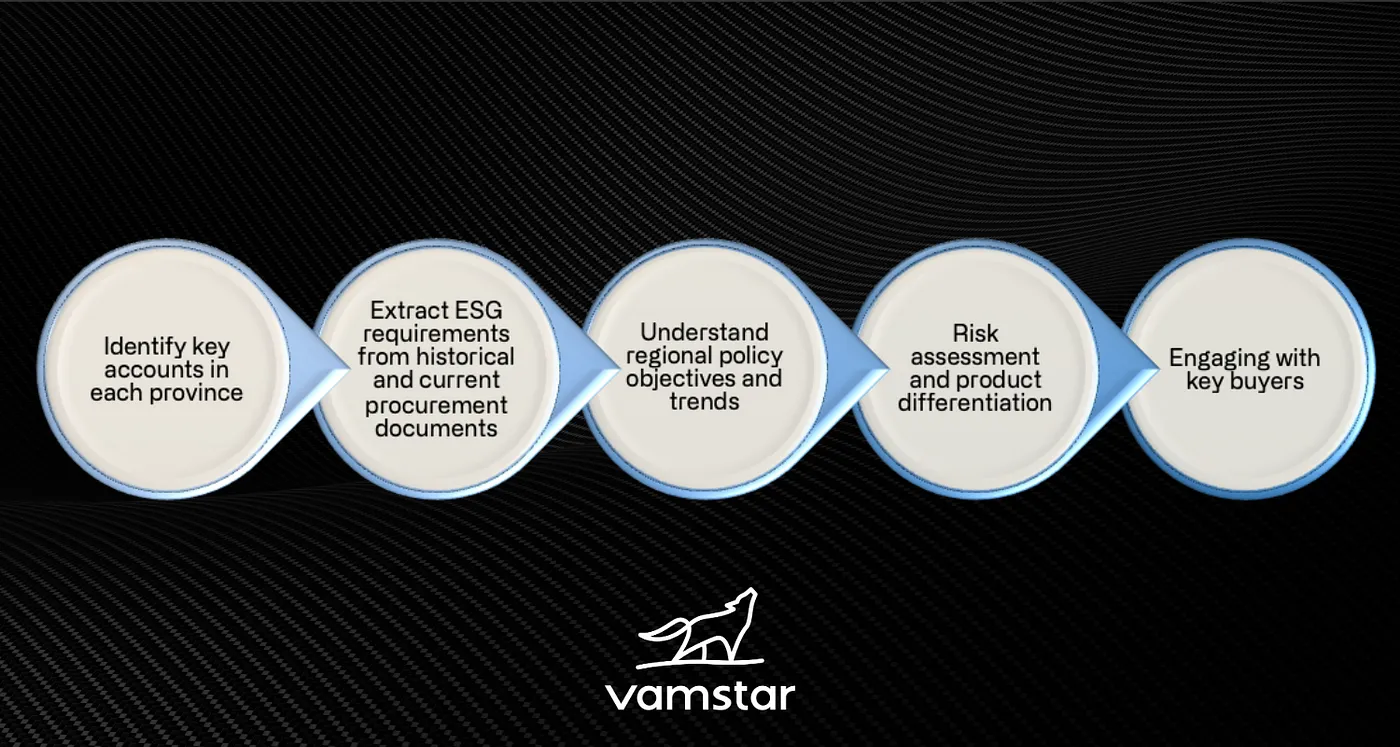
Environmental, Social and Governance in MedTech Key Account Management
In the MedTech sector, where innovation intersects with human health and well-being, ESG considerations hold profound significance. Integrating ESG into Key Account Management Strategies would result in the following advantages:
1. Building Trust and Credibility: Incorporating ESG principles into KAM strategies fosters trust and credibility with key accounts. Aligning buyer’s ESG objectives with the This resonates well with key stakeholders, including healthcare providers, institutions, and regulatory bodies.
2. Risk Mitigation and Compliance: ESG integration in KAM strategies enables companies to identify and mitigate potential risks more effectively. By proactively addressing environmental risks, such as pollution or resource depletion, companies can avoid regulatory fines and reputational damage.
3. Driving Innovation and Differentiation: Embracing ESG considerations within KAM strategies stimulates innovation and differentiation within the MedTech sector.
4. Enhancing Long-Term Relationships: Successful KAM strategies are built on long-term, mutually beneficial relationships with key accounts. By integrating ESG principles into these relationships, companies can deepen engagement and foster loyalty among key stakeholders.
5. Cost Reduction: Sustainable practices can lead to cost savings through reduced waste, energy efficiency, and responsible sourcing.
Conclusion
In the dynamic European MedTech landscape, integrating ESG into your KAM strategy is no longer optional. It’s a strategic imperative for building long-term, sustainable partnerships with key accounts. By understanding your key accounts’ priorities, aligning your efforts with their needs, and building a data-driven ESG narrative, MedTech companies can solidify their position in a rapidly evolving market.


Book a 30 minutes meeting with us
Welcome to our scheduling page! Please choose an available date below to get started.

30 minutes meeting

We’ll email you the meeting link
1 minutes read
Gaining a Competitive Edge: AI Powered Market Intelligence in European Pharma
In the ever-shifting landscape of the European pharmaceutical market, suppliers who wield the power of AI-driven market intelligence gain a critical edge. Traditional methods struggle to provide timely and a data driven intelligence; hindering informed decisions on product development, pricing, and marketing. AI unlocks a gateway to valuable insights, empowering suppliers to navigate this dynamic environment with confidence.
Updated (2026) Article Here.
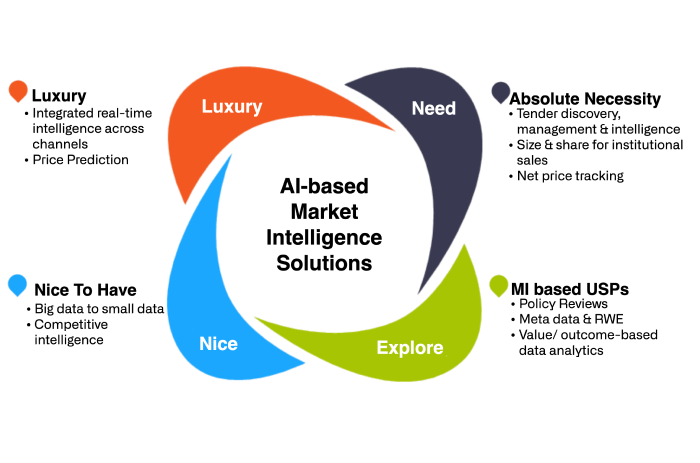
Transformative Technologies in the Pharmaceutical Landscape
In the dynamic landscape of technology, the utilisation of groundbreaking tools like Natural Language Processing (NLP), Machine Learning (ML), and Generative AI presents a myriad of transformative opportunities. We stand on the brink of a profound shift from conventional sample-based market research methods to an era driven by real-time data intelligence. Today, a plethora of AI-powered solutions empowers suppliers to make informed, strategic decisions that transcend the limitations of traditional approaches.
In the contemporary landscape, certain functionalities such as net price tracking, institutional sales tracking, tender discovery, intelligence, and management have become increasingly achievable through the application of Machine Learning (ML) and Natural Language Processing (NLP) tools. Notably, these tools have gained widespread adoption among pharmaceutical suppliers, emerging as indispensable assets for organisations operating within this sector.
Organisational Operations
The integration of ML and NLP technologies has enabled pharmaceutical suppliers to streamline various critical processes, ranging from price tracking to sales analytics and market intelligence. As a consequence, these functionalities have transitioned from being merely innovative to becoming fundamental components of organisational operations within the pharmaceutical domain.
AI-Enabled Scraping Tools for Competitive Analysis
Furthermore, the utilisation of AI-enabled scraping tools facilitates the more effective assessment of competitive behaviour, monitoring of growth strategies, and tactical approaches by generating structured data. Additionally, AI technologies enable the compilation of pertinent information from Big Data sources, amalgamating it with smaller datasets to offer a comprehensive and insightful outlook. Certain niche segment players are leveraging these tools to forecast market trends and formulate commercial strategies, including pricing strategies under scenarios such as Loss of Exclusivity, Go-To-Market initiatives, and product portfolio delineation.
Price prediction and real-time intelligence solutions are currently considered a luxury due to their demanding data requirements, reliance on historically collected datasets, complex implementation processes, high costs, and scalability challenges. Although these solutions offer a decisive competitive advantage, they are often inaccessible to most players in the market.
AI’s Evolving Role in Real-World Evidence (RWE) and Outcome Analysis
The technology is still evolving when it comes to its usage in RWE, Value/ Outcome based analysis. Specifically, certain innovative pharmaceutical companies are leveraging Artificial Intelligence (AI) to sift through vast amounts of publications, generating meta-data to inform their clinical study planning. This is particularly prominent in the design of studies focused on rare diseases. Moreover, Generative AI is being utilised to evaluate the adherence to and impact of various policies. Industry organisations bolster their arguments with data compiled through Natural Language Processing (NLP) and Generative AI techniques.
The European pharmaceutical market is a goldmine for AI technologies, thanks to its wealth of consolidated datasets spanning multiple regions. Pharmaceutical companies can leverage these datasets to implement innovative use cases, gaining a competitive edge that can be expanded globally. By harnessing market intelligence frameworks, companies can craft both long-term commercial strategies and tactical plans to capture market share effectively. Europe’s unique market structure provides the perfect breeding ground for AI-driven advancements in the pharmaceutical industry.
Comprehensive Support for Strategic Decision-Making
Empowering you with essential tools for informed decisions in dynamic market environments.
Harnessing AI’s Potential: Opportunities and Challenges
These cutting-edge tools offer the potential to revolutionise how companies gather, analyse, and interpret data, providing invaluable insights into market trends, competitor behaviour, and consumer preferences. However, harnessing the full potential of AI in this space also comes with its own set of hurdles, ranging from data privacy concerns to the need for robust infrastructure and talent. Some of the key opportunities and challenges include:
| Opportunities | Challenges |
| Review of millions of documents | Marriage of technological expertise with domain knowledge |
| Structuring and matching multiple datasets | Harmonisation of data |
| Data driven instead of sample-based approach | E-catalogues |
| Potential for real time intelligence | Language translations |
| – | Identification of data sources |
Conclusion
Considering their proven efficacy and widespread acceptance, ML and NLP-enabled solutions have solidified their status as essential tools for any organisation operating within the pharmaceutical industry. Their utilisation represents a strategic imperative for staying competitive and responsive to the evolving demands of the market.



Book a 30 minutes meeting with us
Welcome to our scheduling page! Please choose an available date below to get started.
30 minutes meeting
We’ll email you the meeting link
