
























Please provide your email to download the resource

Executive Summary
In today’s highly competitive generics market, pricing strategies can make or break a company’s success. This case study examines the transformative potential of Vamstar’s AI-powered Pricing Co-Pilot solution for a leading generics manufacturer facing challenges in contract pricing and bid optimization.
Key Findings
- Current manual pricing processes result in significant revenue loss and margin erosion.
- Vamstar’s Pricing Co-Pilot has demonstrated a 5% to 80% improvement in win rates and 6-30% improvement in margin profiles across various markets.
- Implementation of the AI solution has shown to prevent €0.8M revenue loss on a single molecule within one market.
This comprehensive analysis presents a compelling case for adopting AI-driven pricing strategies to enhance competitiveness, optimize revenue, and ensure sustainable growth in the challenging generics market.
Introduction
The generics pharmaceutical sector is crucial for global healthcare by providing affordable alternatives to branded medications and increasing availability of essential treatments.
Nevertheless, the industry faces distinct challenges, particularly in terms of pricing and securing contracts in highly competitive markets. The performance of a company in contracts and requests for proposals (RFPs) has a direct impact on 95% of revenues in the generics industry.
Overview | Generics Industry Landscape
The generics industry operates in a complex environment characterized by significant challenges.
GENERICS INDUSTRY CORE CHALLENGES:
INTENSE PRICE COMPETITION: With multiple manufacturers producing identical products, price often becomes the primary differentiator.
REGULATORY PRESSURES: Stringent quality standards and price controls impact profit margins.
MARKET VOLATILITY: Fluctuations in raw material costs and currency exchange rates affect pricing strategies.
SUPPLY CHAIN COMPLEXITIES: Many generics companies rely on imported products, adding another layer of complexity to pricing decisions.
Challenges in Pricing & Bidding for Contracts
Contract processes are a critical component of the generics business model, especially in the European and Asian markets. However, several challenges plague the current approach to pricing and bidding:
LACK OF DATA-DRIVEN DECISION MAKING: Many companies rely on historical knowledge and “gut feel” rather than comprehensive market analysis.
INCONSISTENT PRICING STRATEGIES: With local teams often responsible for pricing decisions, there can be significant variations in approach and outcomes across different markets.
DIFFICULTY IN BALANCING WIN RATES AND PROFITABILITY: Companies struggle to find the optimal price point that maximizes both contract wins and profit margins.
LIMITED MARKET INSIGHTS: Without advanced analytics, it’s challenging to identify and capitalize on market trends and competitor behaviors.
TIME-CONSUMING MANUAL PROCESSES: Traditional methods of analysing historical data and formulating bids are labor-intensive and prone to human error.
INABILITY TO QUICKLY ADAPT TO MARKET CHANGES: Rapid shifts in market dynamics or competitor strategies can render historical data obsolete.
OVER RELIANCE ON INDIVIDUAL EXPERTISE: When pricing decisions depend heavily on the knowledge of a few key individuals, companies risk losing critical insights if these employees leave.
These challenges often result in suboptimal outcomes, including:
- Lost revenue due to overbidding.
- Reduced profit margins from underbidding.
- Inconsistent performance across different markets and product lines.
- Missed opportunities to capture market share.
As the generics industry continues to evolve and face mounting pressures, it’s becoming increasingly clear that traditional approaches to contract pricing are no longer sufficient. The need for a more sophisticated, data-driven approach is evident.
In the following sections, we will delve deeper into the current state of pricing processes, examine the potential for improvement, and explore how Vamstar’s AI-powered Pricing Co-Pilot solution can address these challenges and drive substantial improvements in both win rates and profitability.
Current State Analysis
To fully appreciate the potential impact of an AI-driven pricing solution, it’s crucial to examine the current pricing and bidding processes in detail. This analysis will highlight the limitations and pitfalls of the traditional approach.
Detailed Examination of Current Pricing and Bidding Processes
These steps outline the typical process for pricing and bidding in contracts, as indicated by the information provided:
HISTORICAL DATA REVIEW: Local teams examine past contract results and pricing data.
DISCOUNT ANALYSIS: They look at discounts offered in previous bids, often without a systematic approach to analyzing their effectiveness.
PRICING ASSUMPTIONS: Based on this limited historical view, teams make assumptions about appropriate pricing for the current contract.
GUT-CHECK DECISION MAKING: Final pricing decisions are often based on the intuition or “sense check” of one or two individuals with market experience.
BID SUBMISSION: The decided price is submitted for the contract without a data-driven validation process.
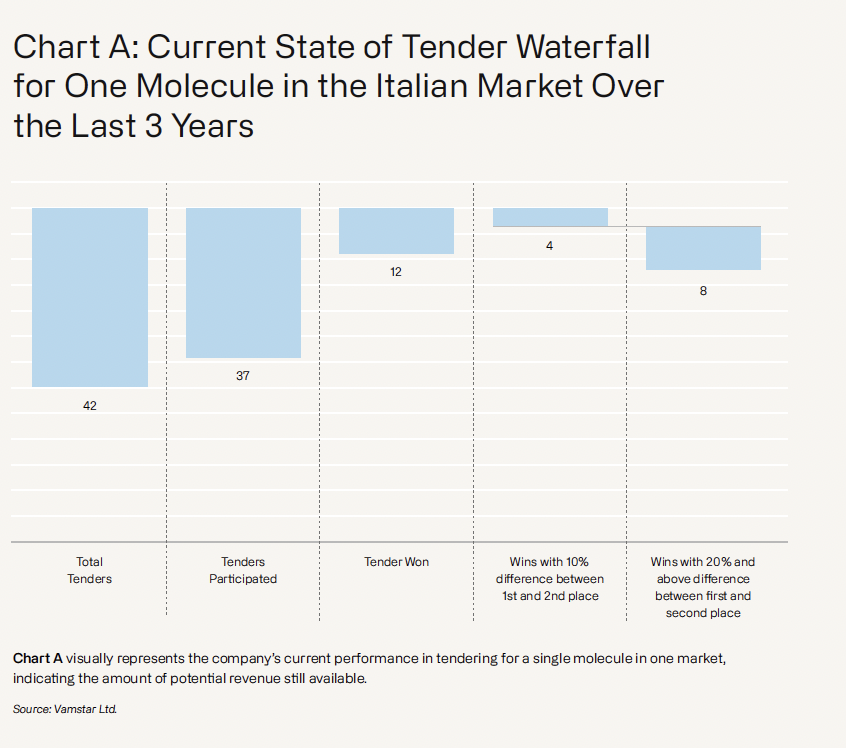
In order to showcase this process, let’s review the information for a top player (Company A) in the Italian market for a specific product in one country over a 3-year timeframe, with a total opportunity space of €15 million.
Limitations and Pitfalls of the Current Approach
- LIMITED DATA UTILIZATION: The current process relies heavily on historical data without incorporating broader market trends or competitor analysis. This narrow focus can lead to missed opportunities and suboptimal pricing decisions.
- INCONSISTENT DECISION MAKING: With pricing decisions often left to the discretion of individuals, there’s a high risk of inconsistency across different contracts and markets. This can result in unpredictable performance and difficulty in identifying best practices.
- LACK OF PRECISION IN PRICING: Company A’s data reveals that their generic tactics often result in subpar revenue generation. This implies that the company frequently drives prices down aggressively to win deals, but this comes at the expense of potential profits.
- INEFFICIENT USE OF RESOURCES: The manual process of analyzing historical data and making pricing decisions is time-consuming and prone to human error. This inefficiency can lead to slower response times and missed opportunities in fast-moving markets.
- LIMITED ABILITY TO OPTIMIZE ACROSS PRICE RANGES: The data in Chart A illustrates different levels of performance in various price categories. Without advanced analysis tools, it is hard to effectively optimize pricing strategies for for each segment, and it is nearly impossible to do so for the entire portfolio.
- DIFFICULTY IN PREDICTING MARKET BEHAVIOR: The current approach lacks the capability to model and predict market behavior based on complex patterns and anomalies in the data. This limits the company’s ability to proactively adjust strategies in response to market shifts.
- INABILITY TO LEVERAGE CROSS-MARKET INSIGHTS: With pricing decisions made locally, there’s limited ability to leverage insights and learnings from other markets or product lines within the company.
- RISK OF KNOWLEDGE LOSS: Relying heavily on the expertise of a few individuals puts the company at risk if these key personnel leave, potentially resulting in a significant loss of market knowledge and pricing acumen.
- CHALLENGES IN MAINTAINING MARGIN PROFILE: The data shows that the generic approach results in a lower percentage of revenue earned out of total potential. This indicates difficulties in maintaining desired margin profiles across all bids.
- MISSED OPTIMIZATION OPPORTUNITIES: As shown in Chart A, there’s significant room for optimization. The current approach leaves money on the table (even at the current win-rate and cost-base), with potential for a 25% improvement in bidding price for the first place and further optimization potential up to the second place price.
These limitations highlight the need for a more sophisticated, data-driven approach to pricing and bidding in contracts. In the next section, we’ll explore why change is necessary and how an AI-powered solution can address these challenges.
The Need for Change
The limitations of the current pricing approach, coupled with evolving market dynamics, underscore the urgent need for a paradigm shift in how generics companies approach contract pricing and bidding.
Market Pressures & Competitive Landscape
The generics industry is facing increasing pressures that make optimized pricing more critical than ever:
1. INTENSIFYING COMPETITION: With more players entering the market, especially from emerging economies, price competition is becoming fiercer.
2. REGULATORY CHANGES: Evolving regulations around pricing and reimbursement in many markets are squeezing margins.
3. SUPPLY CHAIN VOLATILITY: Recent global events have highlighted the vulnerability of supply chains, impacting costs and availability.
4. TECHNOLOGICAL ADVANCEMENTS: Competitors adopting advanced analytics and AI are gaining a competitive edge in pricing strategies.
5. INCREASING CONTRACT COMPLEXITY: Many contracts now involve multiple criteria beyond just price, requiring more sophisticated bidding strategies.
Potential Revenue Loss & Margin Erosion
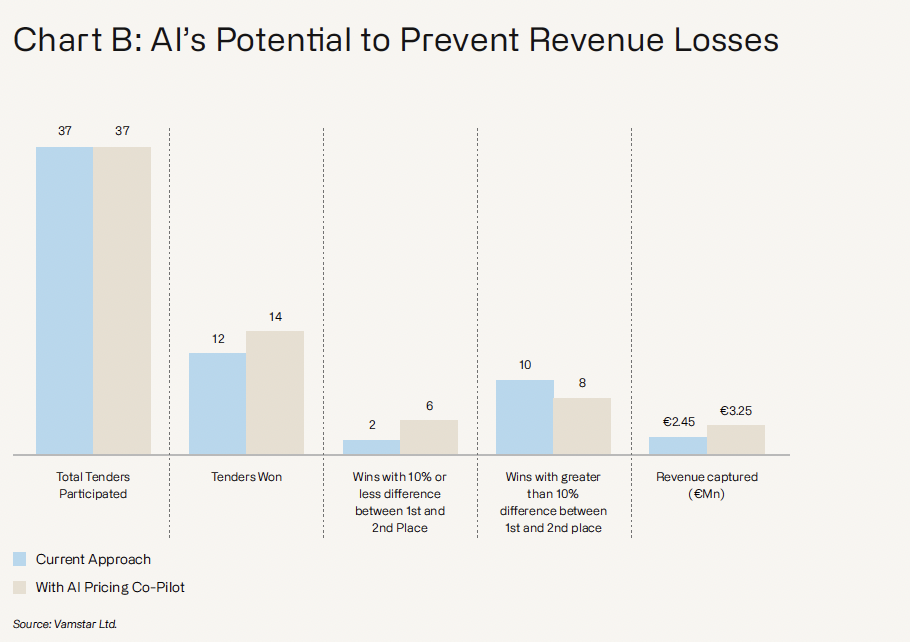
The data provided illustrates the significant financial impact of suboptimal pricing strategies. This chart clearly demonstrates the potential improvements with an AI assisted approach.
Noted Improvements
The data provided illustrates the significant financial impact of suboptimal pricing strategies. This chart clearly demonstrates the potential improvements with an AI-assisted approach.
♦ 80% INCREASED WIN RATES
By incorporating AI into the approach, there is the potential to significantly enhance the success rate, with the possibility of surpassing 80% from the current 30%, depending on the model and optimization needed, ultimately leading to a significant market share increase.
♦ 32% HIGHER REVENUE
The AI-assisted approach could boost revenues by €0.8M to €3.25M from €2.45M, a 32% increase.
♦ 16% IMPROVED BIDDING EFFICIENCY
The AI approach – with the Vamstar model selected by the customer – wins more contracts (14 vs 12) and generates higher margins, indicating optimal pricing.
Long-term Implications of Inaction
Failing to adopt more advanced pricing strategies could lead to several negative outcomes:
1. ERODING MARKET SHARE: As competitors adopt more sophisticated pricing strategies, companies relying on traditional methods may find themselves consistently outbid or operating at unsustainable margins.
2. DECLINING PROFITABILITY: The data shows a potential for significant revenue uplift (€0.8M for just one molecule in one country alone). Multiplied across an entire product portfolio, the cumulative loss from suboptimal pricing could be substantial.
3. MISSED GROWTH OPPORTUNITIES: Without the ability to accurately predict market behavior and optimize bids, companies may miss out on opportunities to expand into new markets or product lines.
4. INEFFICIENT RESOURCE ALLOCATION: Continuing with manual, time-consuming pricing processes diverts valuable resources from other strategic initiatives.
5. LOSS OF COMPETITIVE ADVANTAGE: As the industry evolves, companies that fail to leverage data and AI in their decision-making processes risk falling behind more technologically advanced competitors.
6. INCREASED VULNERABILITY TO MARKET SHOCKS: Without robust, data-driven pricing models, companies are less equipped to quickly adapt to sudden market changes or supply chain disruptions.
The Opportunity for Transformation
While the need for change is clear, it also presents a significant opportunity. By adopting AI-powered pricing strategies, generics companies can:
1. OPTIMIZE REVENUE AND MARGINS: As demonstrated by the potential €0.8M revenue uplift for a single molecule in one market, there’s substantial room for financial improvement.
2. ENHANCE COMPETITIVENESS: Improved win rates (from 30% to over 80% depending on the model chosen and the level of desired optimization between margins and revenue) can lead to increased market share and stronger market positioning.
3. MAKE DATA-DRIVEN DECISIONS: Moving away from gut-feel pricing to data-driven strategies can lead to more consistent and predictable outcomes.
4. IMPROVE OPERATIONAL EFFICIENCY: Supporting much of the pricing process can free up valuable time for strategic thinking and market analysis.
5. GAIN MARKET INSIGHTS: Advanced analytics can provide deeper insights into market trends and competitor behavior, informing broader business strategies.
In the next section, we’ll explore how Vamstar’s Pricing Co-Pilot solution addresses these challenges and capitalizes on these opportunities, providing a pathway to transforming pricing strategies in the generics industry.
Introducing Vamstar’s Pricing Co-Pilot Solution
To address the challenges and capitalize on the opportunities identified, Vamstar has developed the Pricing Co-Pilot, an AI-powered solution designed specifically for the generics industry. This innovative tool leverages advanced machine learning and deep learning algorithms to optimize pricing strategies and improve bidding outcomes.
The Opportunity for Transformation
While the need for change is clear, it also presents a significant opportunity. By adopting AI-powered pricing strategies, generics companies can:
- Optimize Revenue and Margins
- Enhance Competitiveness
- Make Data-Driven Decisions
- Improve Operational Efficiency
- Gain Market Insights.
In the next section, we’ll explore how Vamstar’s Pricing Co-Pilot solution addresses these challenges and capitalizes on these opportunities, providing a pathway to transforming pricing strategies in the generics industry.
Pricing Co-Pilot: Features & Capabilities
The Pricing Co-Pilot is a comprehensive solution that integrates AI, machine learning, and deep learning to develop predictions based on patterns within data, including both direct win-loss data and supplementary data across markets. It’s designed to work alongside human expertise, enhancing decision-making rather than replacing it entirely.
PREDICTIVE ANALYTICS The system uses deep neural networks to analyze historical data and predict market behavior, enabling more accurate pricing decisions.
MULTI-FACTOR ANALYSIS Beyond just historical pricing, the Co-Pilot considers a wide range of factors including market trends, competitor behavior, supply chain dynamics, and regulatory changes.
REAL-TIME MARKET INTELLIGENCE The system continuously updates its models with the latest market data, ensuring that pricing recommendations are always based on current market conditions.
SCENARIO MODELING Users can run “what-if” scenarios to understand the potential outcomes of different pricing strategies before submitting bids.
MARGIN OPTIMIZATION The Co-Pilot is designed to find the optimal balance between win rate and profitability, maximizing overall financial performance.
CUSTOMIZABLE RISK PROFILES Companies can set their own risk tolerances, allowing the system to tailor its recommendations to align with corporate strategy.
USER-FRIENDLY INTERFACE Despite its complex underlying algorithms, the Co-Pilot presents information in an easily understandable format in MS-Excel, facilitating quick decision-making.
INTEGRATION CAPABILITIES The system can integrate with existing ERP, CRM, and Price/Revenue Management systems, ensuring seamless data flow and minimal disruption to current processes.
Pricing Co-Pilot Illustrated
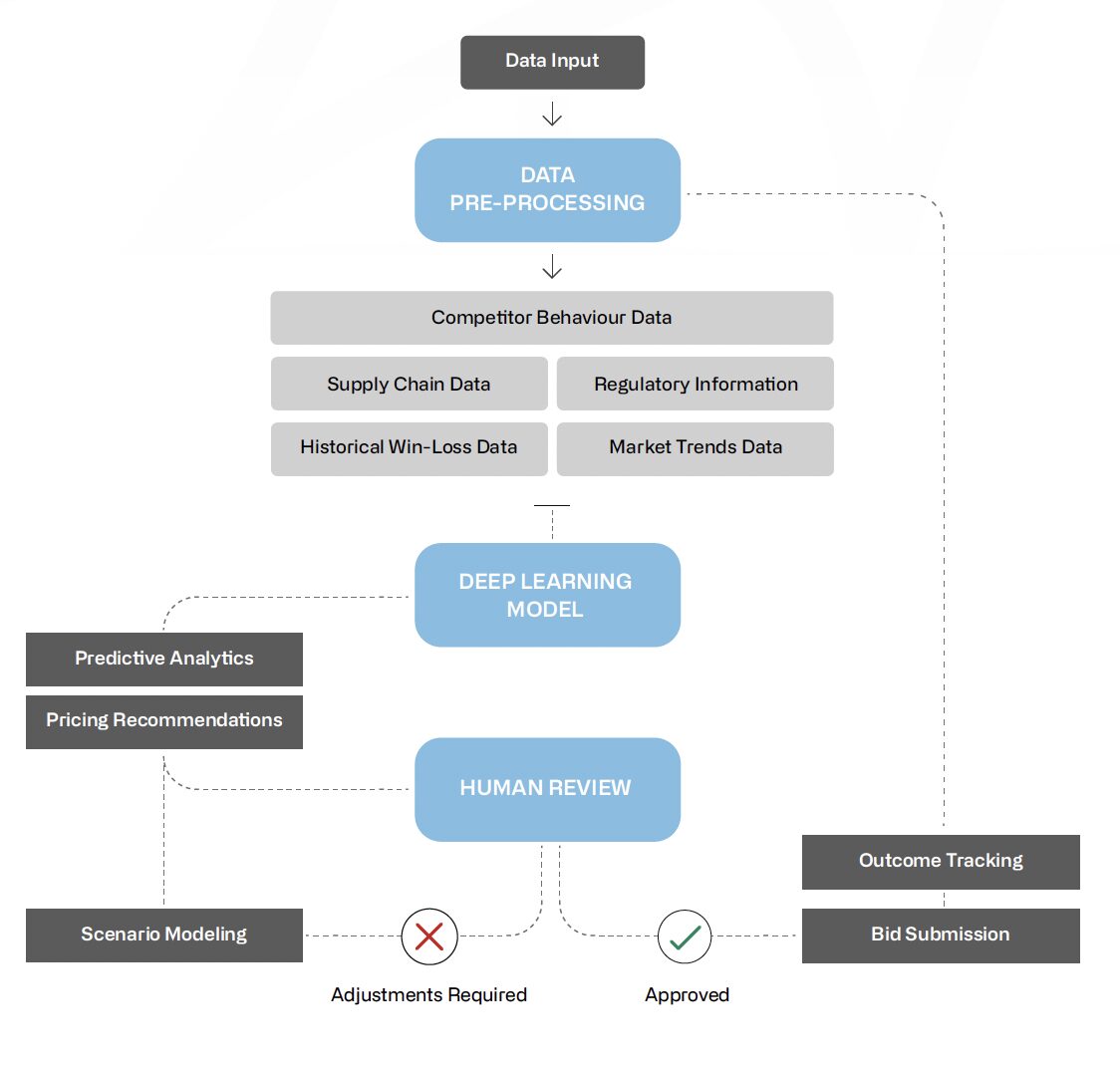
To illustrate the functionality of the Pricing Co-Pilot, please scroll through the flowchart below. This flowchart demonstrates the cyclical nature of the Pricing Co-Pilot, where each bid outcome feeds back into the system, continuously improving its predictive capabilities.
Benefits of Implementation
IMPROVED WIN RATES As evidenced by the data in Chart B, the Pricing Co-Pilot can increase win rates from 30% to over 80%, depending on the level of desired optimization between margins and win-rates.
REVENUE OPTIMIZATION: The system has demonstrated the ability to prevent €0.8M revenue loss on a single molecule (Chart B).
MARGIN PROTECTION: By finding the optimal price point, the Pricing Co-Pilot helps maintain or improve margin profiles.
CONSISTENCY ACROSS MARKETS: The AI-driven approach ensures consistent pricing strategies across different geographical markets and product lines.
TIME EFFICIENCY: Automating much of the analysis and prediction process frees up valuable time for strategic decision-making.
RISK MANAGEMENT: The ability to model different scenarios helps companies better understand and manage pricing risks.
COMPETITIVE ADVANTAGE: Early adopters of this technology can gain a significant edge in the highly competitive generics market
To further illustrate the potential impact, let’s examine the optimization potential as shown in Chart C:
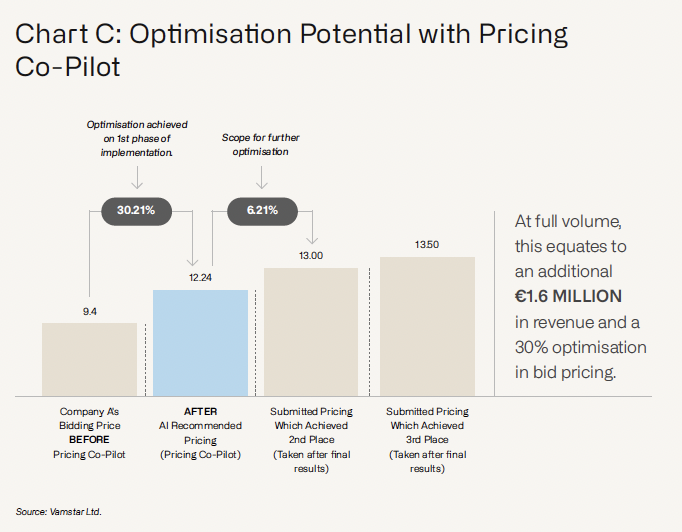
The previous chart (Chart C) clearly illustrates the significant optimization potential:
- Current First Place Bid: €9.40
- Optimized Bid with Pricing Co-Pilot: €12.24 (30.21% increase)
- Second Place Price: €13.00
- Third Place Price: €13.50
The Pricing Co-Pilot enables a 30.21% increase in the bidding price while still maintaining the winning position. This represents a substantial revenue and margin improvement opportunity. Furthermore, there’s additional optimization potential up to the second place price, potentially allowing for even greater revenue gains without losing the contract.
In the next section, we’ll delve deeper into the technology and methodology behind the Pricing Co-Pilot, explaining how it achieves these impressive results.
The Underlying Technology
to understand the underlying technology and methodology
that powers its predictive capabilities.”
Praful Mehta,
CEO, Vamstar
Deep Dive into the Technology
The Pricing Co-Pilot leverages state-of-the-art deep learning models, specifically deep neural networks, to analyze complex patterns in historical and real-time data. Here’s a breakdown of the key technological components.
DEEP NEURAL NETWORKS: These are sophisticated machine learning models inspired by the human brain. They consist of multiple layers of interconnected nodes, allowing them to learn and represent complex, non-linear relationships in data.
REINFORCEMENT LEARNING: The system employs reinforcement learning techniques to continuously improve its predictions based on the outcomes of previous bids.
NATURAL LANGUAGE PROCESSING: NLP algorithms are used to extract relevant information from unstructured data sources such as contract documents and market reports
Methodology
The Pricing Co-Pilot follows a sophisticated methodology to generate its pricing recommendations:
1. DATA COLLECTION: The system aggregates data from various sources, including: Historical contract data (win/loss, pricing, volumes), Market intelligence reports, Competitor pricing information, Economic indicators, Regulatory updates and Supply chain updates.
2. DATA PREPROCESSING: Raw data is cleaned, normalized, and structured for analysis. This step includes handling missing values, outlier detection, and data standardization.
3. FEATURE ENGINEERING: The system creates relevant features (up-to 400+ features) from the raw data that can serve as inputs to the predictive models. This might include derived metrics such as price elasticity, market share trends, or seasonality indicators.
4. MODEL TRAINING: Multiple deep learning models are trained on the preprocessed data. These models learn to predict various outcomes, such as the probability of winning a contract at different price points and the expected revenue.
5. PREDICTION GENERATION: For a new contract, the trained models generate predictions across a range of potential bid prices. These predictions include: Probability of winning, Expected revenue, Projected market share impact, Potential competitor responses.
6. HUMAN REVIEW: The system presents its recommendations to human experts, who can review, adjust, and approve the final bid price.
7. BID SUBMISSION: Once approved, the bid is submitted to the contract.
8. OUTCOME ANALYSIS: After the contract results are known, the system analyzes the outcome, comparing its predictions to the actual results.
9. MODEL REFINEMENT: Based on the outcome analysis, the models are fine-tuned to improve future predictions. This continuous learning process ensures that the system becomes more accurate over time.
Data Inputs and Outputs
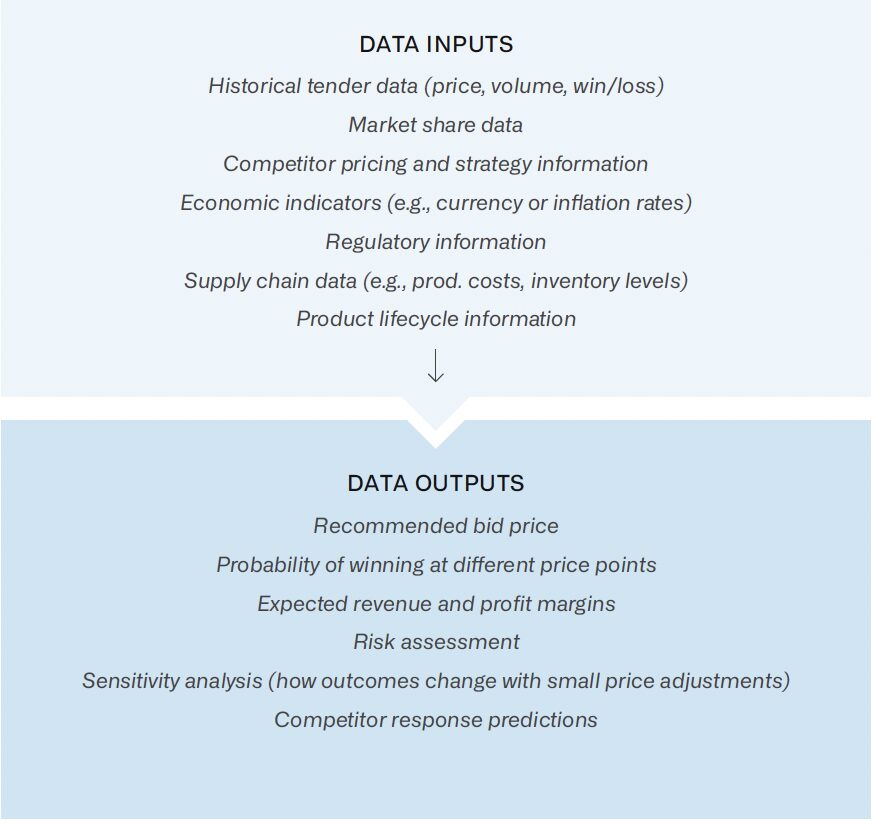
To illustrate the impact of the Pricing Co-Pilot, let’s examine the data from Chart D.
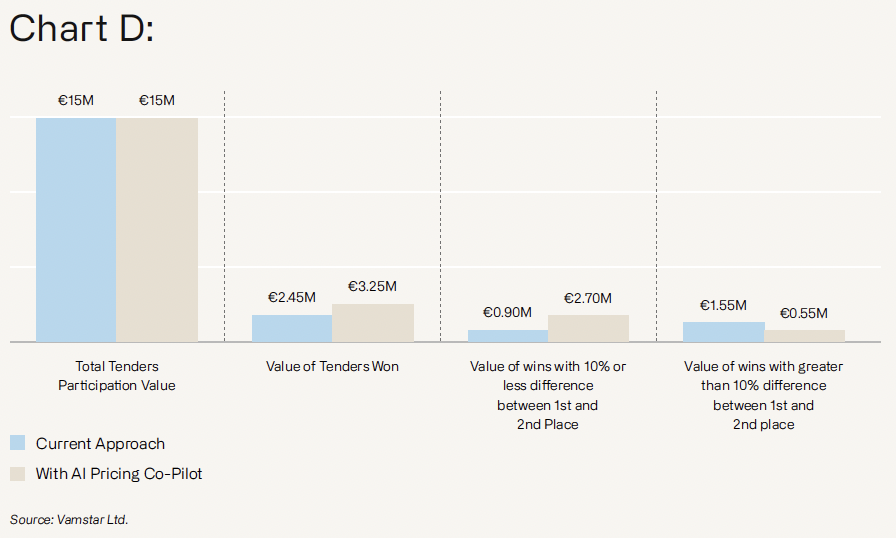
methods in the same contracts.
This chart reveals several key insights:
- IMPROVED VALUE CAPTURE: While the Vamstar Co-Pilot wins slightly more contracts (based on the level of optimization selected), it captures significantly more value – greater than 200%.
- STRATEGIC WIN DISTRIBUTION: The Co-Pilot’s primary goal is to capture greater value in bids, evident from the significant increase in total value obtained with less than a 10% difference between the top two winning bids.
- RISK MANAGEMENT: The Co-Pilot reduces exposure to high-risk, low-margin wins, as shown by the lower number of wins in the >10% price difference category.
- OVERALL EFFICIENCY: Despite winning slightly higher contracts, the Co-Pilot generates €3.25M in revenue compared to €2.45M for the generic approach, a 32% improvement.
These results demonstrate the Pricing Co-Pilot’s ability to not just win contracts, but to win the right contracts at the right prices, maximizing overall value for the company. In the next section, we’ll explore the benefits of implementing the Pricing Co-Pilot in more detail, including case studies and success stories from various markets.
Benefits of Implementation
The implementation of Vamstar’s Pricing Co-Pilot offers numerous benefits that directly address the chal- lenges faced by generics companies in today’s competitive market. Let’s explore these benefits in detail, supported by data from our case studies and success stories.
Improved Win Rates
A key benefit of the Pricing Co-Pilot is its ability to significantly boost contract win rates. Our data shows a clear improvement, with win rates increasing from 30% before implementation to a more optimized level, enhancing revenue without compromising margins. This leads to greater market share and revenue potential.
Optimized Pricing and Margins
The Pricing Co-Pilot doesn’t just win more contracts; it wins them at optimal prices, protecting and often improving margin profiles. Let’s revisit the optimization potential we saw earlier:
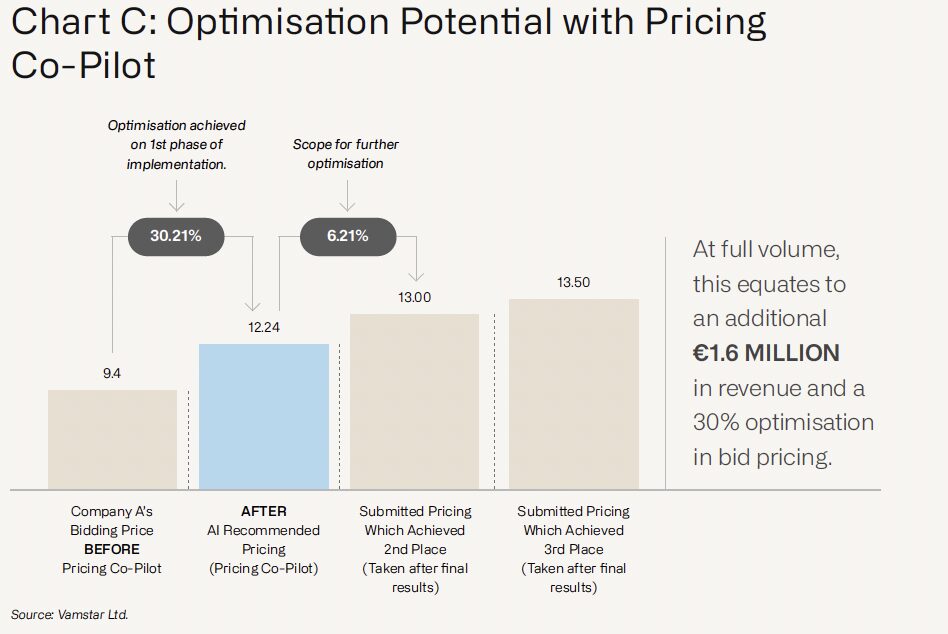
This chart demonstrates how Pricing Co-Pilot optimizes bid pricing:
- Without the Co-Pilot, the company bid at €9.40.
- With the Co-Pilot, the bid was optimized to €12.24.
- The 2nd-place bid was €13, showing room for further optimization.
This optimization represents a 30.21% increase in bid price while still winning the contract, directly translating to improved margins & revenue.
Data-Driven Decision Making
The Pricing Co-Pilot transforms the contract bidding process from one based on intuition and limited historical data to a comprehensive, data-driven approach.
This shift brings several advantages:
- CONSISTENCY: Decisions are based on a standardized set of data points and algorithms, reducing variability across different markets or product lines.
- OBJECTIVITY: The AI-driven approach reduces the impact of personal biases or incomplete market knowledge.
- COMPREHENSIVE ANALYSIS: The system considers a wider range of factors than humanly possible, including subtle market trends and competitor behaviors.
- REAL-TIME ADAPTABILITY: The Co-Pilot can quickly adjust to new market information, allowing for more agile pricing strategies.
Efficiency and Resource
Allocation Implementing the Pricing Co-Pilot significantly reduces the time and resources required for pricing decisions:
- AUTOMATED ANALYSIS: The system can process vast amounts of data and generate pricing recommendations in a fraction of the time it would take a human team.
- SCENARIO MODELING: The Co-Pilot can quickly model multiple pricing scenarios, allowing teams to explore various strategies efficiently.
- FOCUS ON STRATEGY: By automating much of the data analysis and prediction process, the system frees up valuable time for strategic decision-making and market analysis.
Risk Management
The Pricing Co-Pilot enhances risk management in several ways:
- PROBABILITY ASSESSMENT: For each potential bid price, the system provides a probability of winning, allowing for more informed risk-reward decisions.
- MARGIN PROTECTION: By optimizing bid prices, the system helps protect against margin erosion in highly competitive contracts.
- MARKET IMPACT ANALYSIS: The Co-Pilot can predict the potential market share and competitive impacts of different pricing strategies, helping to avoid unintended negative consequences.
Competitive Advantage
Early adopters of AI-driven pricing strategies gain a significant competitive advantage:
- FASTER RESPONSE TIMES: The ability to quickly generate optimized bids allows companies to respond more rapidly to market opportunities.
- IMPROVED MARKET INTELLIGENCE: The system’s continuous learning provides ever-improving insights into market dynamics and competitor behaviors.
- STRATEGIC PRICING: The ability to fine-tune pricing strategies for different market segments or product lines allows for a more nuanced and effective competitive approach.
Long-Term Financial Impact
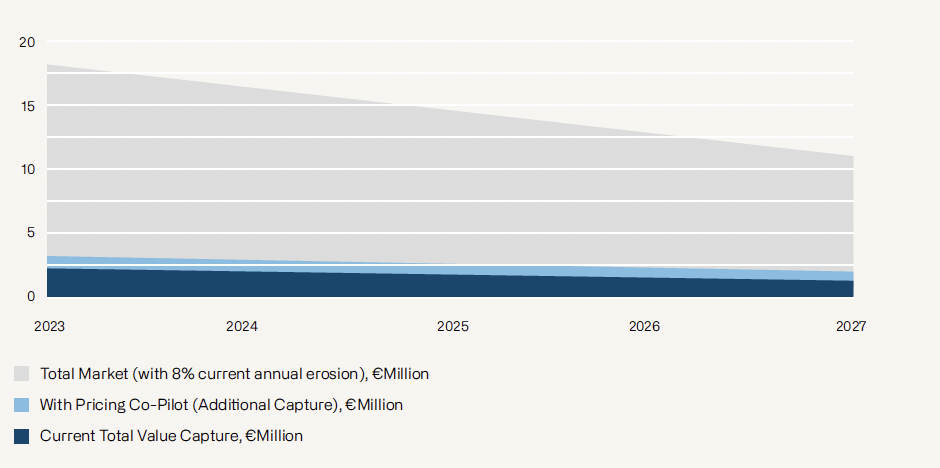
The cumulative effect of these benefits translates into substantial long-term financial improvements as shown in the chart below. In a declining market, AI can generate an additional €3.2M by optimizing the bidding corridor for a single molecule over 5 years.
Implementation Process
Implementing the Vamstar Pricing Co-Pilot is designed to be a smooth and efficient process, minimizing disruption to ongoing operations while quickly delivering value. Here’s a detailed look at the implementation process and the resources required.
Timeline and Phases
The typical implementation timeline for a pilot program is 6-9 weeks, broken down into the following phases:
- PHASE 1: DATA COLLECTION & PREPARATION (3 WEEK): Gather historical contract data, market information, and competitor insights. Clean and structure data for system ingestion.
- PHASE 2: MODEL TRAINING & VALIDATION (2 WEEK): Train the AI models on the company’s specific data. Validate model outputs against known historical outcomes.
- PHASE 3: USER TRAINING & A/B TE STING (2 WEEK): Train key users on the system. Run the Pricing Co-Pilot in parallel with existing processes for comparison.
- PHASE 4: GO-LIVE & PER FORMANCE MONITORING (2 WEEKS): Fully deploy the Pricing Co-Pilot for live contract bidding. Monitor performance and make necessary adjustments.
Resource Requirements
The implementation process is designed to be resource-efficient, requiring minimal
input from the client company:
1. PERSONNEL:
- One project manager (part-time commitment)
- One local country expert (approximately 5 working days total)
- Key users from the pricing and contract teams (for training and feedback)
2. DATA:
- Historical contract data (preferably 2-3 years)
- Market intelligence reports
- Vamstar datasets
- Competitor pricing information (if available)
3. TIME COMMITMENT:
- Kickoff meeting: 2-3 hours
- Weekly status meetings: 1 hour per week
- Training sessions: 2-3 hours per key user
- Final review and go-live decision: 2-3 hours
Integration with Existing Systems
The Pricing Co-Pilot is designed to integrate seamlessly with existing ERP, CRM, and Price/Revenue Management systems.
This integration ensures:
- REAL-TIME DATA FLOW: The latest market and contract information is always available to the AI models.
- CONSISTENT DATA USAGE: All departments work with the same, up-to-date information.
- STREAMLINED WORKFLOW: Pricing recommendations can be easily incorporated into existing contract response processes.
Change Management
Successful implementation of the Pricing Co-Pilot often requires some degree of change management.
To facilitate this, Vamstar provides:
- EXECUTIVE BRIEFINGS: To ensure leadership understanding and buy-in.
- USER WORKSHOPS: To address concerns and demonstrate the system’s value.
- ONGOING SUPPORT: A dedicated support team to assist with any issues post-implementation.
Pilot Program Structure
For companies looking to validate the Pricing Co-Pilot’s effectiveness before full deployment, we recommend a structured pilot program:
- SCOPE: Select 1-2 key markets or product lines for the pilot.
- DURATION: 3-6 months, depending on contract frequency.
- SUCCESS METRICS: Define clear KPIs such as win rate improvement, revenue increase, and margin enhancement.
- PARALLEL RUNNING: Continue existing processes alongside the Co-Pilot for direct comparison.
- REGULAR REVIEWS: Conduct monthly performance reviews to track progress and address any issues.
Scaling Up
After a successful pilot, scaling up to full implementation typically involves:
- Expanding data inputs to cover all relevant markets and products.
- Training additional users across different departments and regions.
- Refining AI models based on broader data sets and user feedback.
- Integrating the Pricing Co-Pilot into standard operating procedures for all
contract responses.
By following this structured implementation process, companies can quickly begin realizing the benefits of AI-powered pricing optimization while minimizing disruption to their existing operations. The scalable nature of the solution ensures that as more data is collected and the models are refined, the performance improvements will continue to grow over time.
In the next section, we’ll address common concerns and objections that management teams often have when considering the adoption of AI-powered pricing solutions.
Addressing Concerns & Objections
When considering the adoption of an AI-powered solution like the Pricing Co-Pilot, management teams often have valid concerns and objections. Addressing these proactively is crucial for successful implementation and adoption. Let’s explore some common concerns and provide detailed responses.
Data Reliability and Trust
Our market is unique and complex.”
- CUSTOMIZED TRAINING: The Pricing Co-Pilot is trained on your company’s specific historical data combined with curated market data, ensuring it understands the nuances of your market.
- CONTINUOUS LEARNING: The system continuously updates its models based on new data and outcomes, improving accuracy over time.
- TRANSPARENCY: The Co-Pilot provides explanations for its recommendations, allowing users to understand the factors influencing each decision.
- VALIDATION PROCESS: During implementation, we run a parallel testing phase where the AI’s recommendations are compared to actual outcomes and traditional methods.
- HUMAN OVERSIGHT: The system is designed to augment human decision-making, not replace it. Final decisions always remain with your team.
Balancing AI Recommendations with Human Expertise
We value their market knowledge.”
- AUGMENTATION, NOT REPLACEMENT: The Pricing Co-Pilot is designed to enhance human decision-making, not replace it. It provides data-driven insights to support your team’s expertise.
- INCORPORATING HUMAN INSIGHTS: The system allows for manual adjustments and can learn from these interventions, incorporating human expertise into its models.
- FREEING UP STRATEGIC THINKING: By automating data analysis and initial pricing recommendations, the Co- Pilot frees up your team to focus on higher-level strategy and relationship management.
- KNOWLEDGE PRESERVATION: The system can capture and utilize the knowledge of your most experienced team members, preserving this valuable asset even if personnel changes occur.
- CUSTOMIZABLE CONFIDENCE THRESHOLDS: You can set confidence thresholds for automated decisions, ensuring human review for any recommendations below these thresholds. To illustrate how human expertise and AI work together, please refer to our earlier process map.
Return on Investment and Cost Concerns
the investment?”
- CLEAR ROI METRICS: As demonstrated in our case studies, the Pricing Co-Pilot has shown significant improvements in win rates, revenues, and margins. For example, preventing €0.8M revenue loss on a single molecule in one market.
- SCALABILITY: The system’s value increases as it’s applied across more products and markets, with minimal additional cost.
- EFFICIENCY GAINS: By automating much of the data analysis and initial pricing recommendations, the system reduces the time and resources required for contract responses.
- RISK MITIGATION: More accurate pricing reduces the risk of leaving money on the table or losing contracts due to overbidding.
- COMPETITIVE ADVANTAGE: Early adopters of AI-powered pricing gain a significant edge in the market, potentially leading to increased market share and customer trust.
Implementation Challenges and Disruption Concerns
current operations?”
- PHASED IMPLEMENTATION: The 4-9 week implementation process is designed to minimize disruption, with most of the work done in parallel to existing operations.
- MINIMAL RESOURCE REQUIREMENTS: As outlined earlier, the implementation requires limited time from your team – primarily one part-time project manager and about 5 working days from a country expert or country SME (subject matter expert).
- SEAMLESS INTEGRATION: The Pricing Co-Pilot is designed to integrate with existing ERP, CRM, and Price/ Revenue Management systems, ensuring a smooth workflow.
- COMPREHENSIVE TRAINING: We provide thorough training for all key users, ensuring they’re comfortable with the system before full deployment.
- PILOT PROGRAM: For those concerned about widespread disruption, we offer to start with a limited pilot in one or two markets before full rollout.
- DEDICATED SUPPORT: Our team provides ongoing support throughout the implementation and beyond, quickly addressing any issues that arise. By addressing these concerns head-on and providing clear, data-driven responses, we can build confidence in the Pricing Co-Pilot’s ability to deliver significant value with minimal disruption.
Conclusion and Next Steps
This White Paper examined the potential of Vamstar’s AI-powered Pricing Co-Pilot solution for a series of leading generic manufacturers facing challenges in contract pricing and bid optimization. The generics industry operates in a complex environment with intense price competition, regulatory pressures, and market volatility. Current manual pricing processes often result in significant revenue loss and margin erosion due to inconsistent strategies, limited market insights, and overreliance on individual expertise.
Vamstar’s Pricing Co-Pilot addresses these challenges by leveraging advanced machine learning and deep learning algorithms to optimize pricing strategies and improve bidding outcomes. The system has demonstrated impressive results, including 20% to 40% improvement in win rates and 6-30% improvement in margin profiles across various markets. In one instance, it prevented €0.8M revenue loss on a single molecule within one market.
The implementation process is designed to be smooth and efficient, typically taking 6-9 weeks for a pilot program. It requires minimal resource commitment from the client company and can be integrated seamlessly with existing systems. The solution offers numerous benefits, including improved win rates, optimized pricing and margins, data-driven decision making, enhanced risk management, and a significant competitive advantage.
While management teams may have concerns about data reliability, the balance between AI and human expertise, return on investment, and potential disruption to current operations, the case study addresses these issues comprehensively.

